Grand Hall of the Palais de Justice
The Hunchback of Notre DameThe Grand Hall of the Palais de Justice is a vast medieval hall where Parisian civic authority and popular spectacle meet. On January 6, 1482, it draws a packed crowd for a mystery play and the election of the Pope of the Fools; its seven pillars, royal statues, court furnishings, and temporary stage make the building more than a backdrop. The hall’s later loss gives the narrator’s reconstruction a second purpose: to preserve in words a public space that no longer survives intact.
Setting and Architectural Form
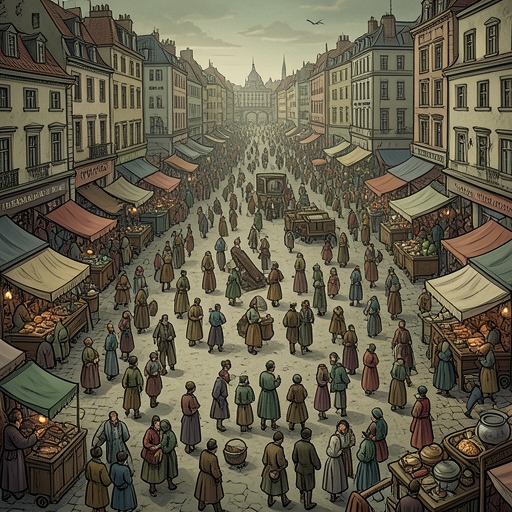
The hall is described as an immense oblong enclosure, then reputed to be the largest covered space in the world, though the narrator qualifies the claim by noting that the Grand Hall of the Château of Montargis had not yet been measured by Sauval. On the January day, the scale is felt through the crowd: people press toward the entrance, streams of arrivals pour into the palace square, and the grand staircase carries a ceaseless double current of people up and down. Seen from outside, the staircase seems to spill into the square like a cascade into a lake. The tumult at the entrance makes the hall’s capacity—and the limits of that capacity—part of the scene.
Inside, a double ogive vault rises above a black-and-white marble pavement. Seven pillars divide the length of the hall and support the vault’s arches. Around four pillars are merchants’ stalls, bright with glass and tinsel; around the remaining three stand oak benches, polished by the clothing of litigants and lawyers. The arrangement places trade beside legal business within a single monumental interior. Along the walls, windows, doors, and pillars, a continuous series of statues represents the kings of France, from Pharamond onward. The narrator distinguishes the depicted rulers by posture: some hang their arms and lower their eyes, while others lift heads and arms boldly. The royal sequence turns the walls into a visible history of monarchy.
The hall’s surfaces were once richly colored. Vaults, pillars, walls, doorways, panelling, and statues had been illuminated in blue and gold; by the period being described, the finish was already tarnished. By 1549, dust and spiders had almost entirely obscured it, although Du Breul still admired the decoration through inherited reports. The narrator also pauses over the word Gothic, accepting it as the established name for the architecture of the later Middle Ages while acknowledging that the term is imperfect. That qualification frames the building as a historical object whose familiar labels cannot fully contain its changing forms.
The January Festival and Its Stage
The hall fills for the combined observance of Epiphany and the Feast of Fools. The day’s festivities are divided among three destinations: a bonfire on the Place de Grève, a maypole at the Chapelle de Braque, and a mystery play at the Palais de Justice. Many of the crowd choose either the bonfire or the play, leaving the maypole exposed to the January sky. The hall attracts particular attention because the Flemish ambassadors, recently arrived in Paris, are expected to attend both the play and the election of the Pope of the Fools.
The performance converts the hall’s marble table into a theater. On its slabs, already scratched by the heels of law clerks, carpenters have erected a high wooden framework. Its upper surface serves as the stage; tapestries conceal the space within as dressing rooms. A ladder on the outside links backstage to the platform and must be used for every entrance, exit, or sudden theatrical effect. The arrangement is rudimentary, and the narrator treats its visible mechanics as part of the play’s charm: the audience can see how the illusion is assembled, and the actors cannot move without negotiating the ladder. Four palace sergeants stand at the table’s corners, guarding a popular entertainment in a room otherwise associated with courts and litigants.
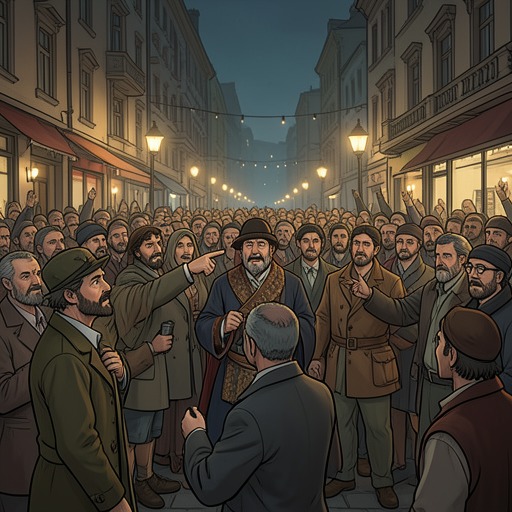
The performance is scheduled to begin at noon, when the great palace clock strikes twelve. The hour has been set late to accommodate the ambassadors. In the meantime, the crowd waits, and the hall’s atmosphere shifts from the turbulence at the entrance to an expectant audience. When Pierre Gringoire identifies himself as the author, the people who had been noisy moments before wait quietly, at least briefly. That pause is overturned when Jacques Coppenole criticizes the play for offering verbal quarrels instead of physical action and proposes a grimace-based election modeled on Ghent’s Feast of Fools. The audience receives the proposal enthusiastically, and Gringoire is unable to resist the change in public attention. In the hall, the theatrical program can be displaced by the crowd’s appetite for a different spectacle.
Civic Authority and the City’s Divisions
The Grand Hall belongs to a Paris structured by overlapping jurisdictions rather than a single, uniform civic authority. The City, the Town, and the University each have a distinct character and institutional center: churches mark the City, palaces the Town, and colleges the University. The island falls under the bishop, the right bank under the provost of the merchants, and the left bank under the Rector, while the provost of Paris, a royal rather than municipal official, presides over the whole. The hall’s position within the Palais de Justice connects it to this fragmented order of government and law.
The arrangement of the room makes that connection tangible. Its benches bear the wear of litigants and attorneys; merchants occupy stalls among the pillars; royal figures line the walls. Legal business, commerce, monarchy, and public entertainment are not segregated into wholly separate worlds. Yet the city’s jurisdictional divisions have practical consequences: offences committed by scholars on the left bank are tried in the courts on the island and punished on the right bank at Montfaucon, unless the Rector intervenes under the University’s privileges. The Grand Hall stands within a legal landscape where authority is distributed and contested, even as the royal statues present a continuous line of kings.
Destruction and Historical Memory
The hall’s survival becomes a question of contingency in the narrator’s account. He links the fire of 1618 to the assassination of Henri IV, the disappearance of documents connected with Ravaillac’s trial, and the destruction of the clerk’s office and then the Palais de Justice. But he immediately qualifies this explanation: Ravaillac may have had no accomplices, or any accomplices may have had no connection to the fire. He also notes alternative explanations offered at the time, including a fiery object said to have fallen from the sky and a quatrain attributed to Théophile. The building’s destruction is therefore narrated through competing accounts, not as a settled chain of causes.
Had the old Palais survived, the narrator suggests, readers could have been directed to see its ancient hall for themselves. Instead, he must reconstruct it in prose. That reconstruction preserves particular details—the marble table, worn benches, seven pillars, blue-and-gold decoration, and crowded staircase—while also recovering the changing uses that made the interior socially alive. The Grand Hall is at once a record of architecture and a place where Paris gathers to watch, wait, judge, and be entertained. Its loss turns description into a substitute for direct encounter, and its remembered spectacle into part of the city’s history.